
Power plants are no longer simple systems. Today, solar PV, wind turbines, and battery storage systems operate together and connect to the grid at a common point. This integration improves energy utilization, but it also creates a serious challenge. Multiple technologies with different characteristics must work together as one system. If coordination fails, you will see voltage instability, poor power quality, frequent tripping, and failure to meet grid code requirements. This is where the Power Plant Controller (PPC) becomes critical.
The PPC is the central control system of the plant. It continuously monitors grid conditions and controls plant output in real time. It manages active power, reactive power, voltage, and frequency at the Point of Connection (POC). More importantly, it coordinates multiple plant components so that the entire facility behaves like a single controllable unit from the grid’s point of view.
In a hybrid plant, each component behaves differently. Solar inverters respond quickly but are limited by current and thermal constraints. Wind turbines have mechanical inertia and control delays. Battery systems can respond fast but are limited by state of charge and power rating. Reactive compensation devices are designed specifically for voltage control but operate within fixed limits. The PPC brings all these elements under one coordinated control strategy.
Reactive power plays a key role in maintaining voltage stability. When voltage drops, the system demands more reactive power. This relationship increases stress on both the grid and the plant. If reactive support is not available at the right time, voltage collapse or instability can occur. Grid operators define strict requirements for reactive power capability. In most cases, renewable plants must provide reactive support in the range of ±33% of installed active power capacity. This means a 300 MW plant must be capable of providing around ±100 MVAr. Without proper PPC control, meeting this requirement becomes difficult, especially during dynamic conditions.
A typical hybrid renewable plant includes:
- Solar PV inverters
- Wind turbine generators
- Battery Energy Storage System (BESS)
- Reactive compensation equipment such as STATCOM, SVG, synchronous condensers, and capacitor banks
Each of these components has different strengths and limitations. Solar and wind inverters can provide reactive power, but doing so reduces their ability to export active power. This directly impacts revenue. STATCOM and synchronous condensers, on the other hand, are designed specifically for reactive power support. They respond quickly and do not affect active power generation. The challenge is to use each component in the most efficient way.
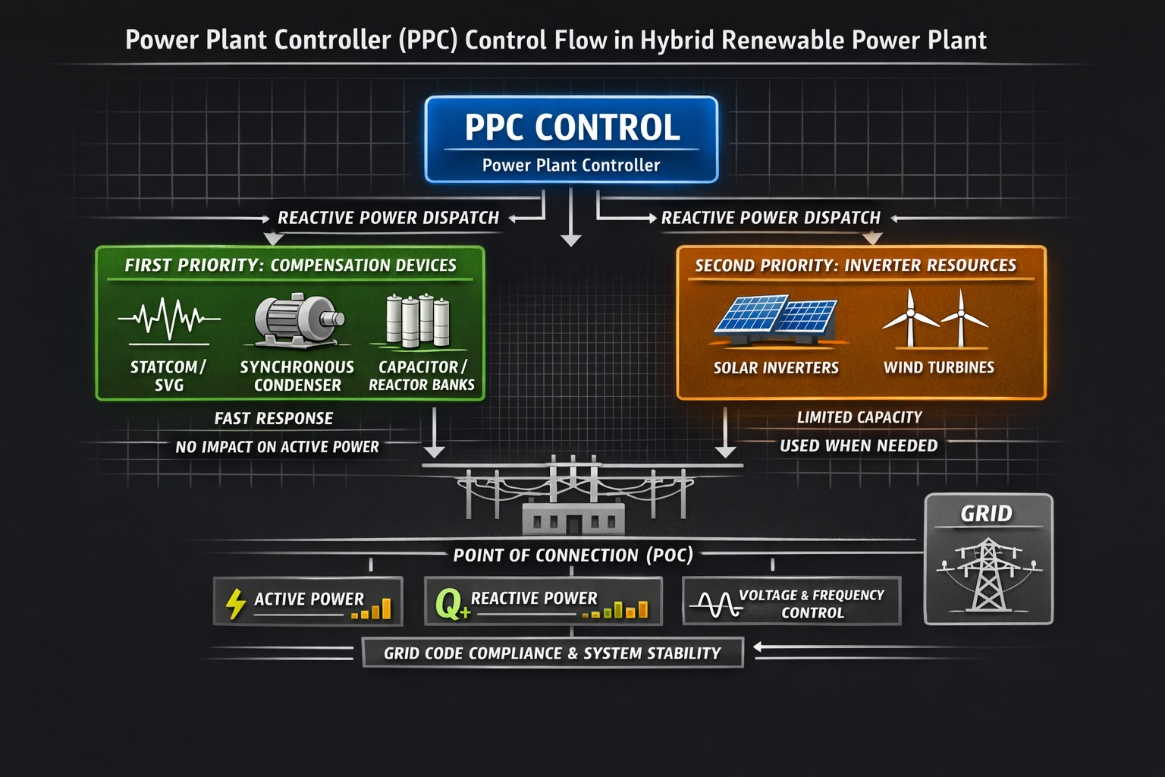
The PPC follows a hierarchical control approach. This is the core of the entire system. First, reactive compensation devices are used. These include STATCOM, SVG, synchronous condensers, and capacitor or reactor banks. These devices are designed for fast response and can supply reactive power without reducing active power generation. Only when these devices reach their limits does the PPC use inverter-based resources such as solar and wind systems. This approach ensures that the plant delivers maximum active power while still meeting grid requirements.
Practical Example: 275 MW Hybrid Plant
Consider a 275 MW hybrid renewable plant.
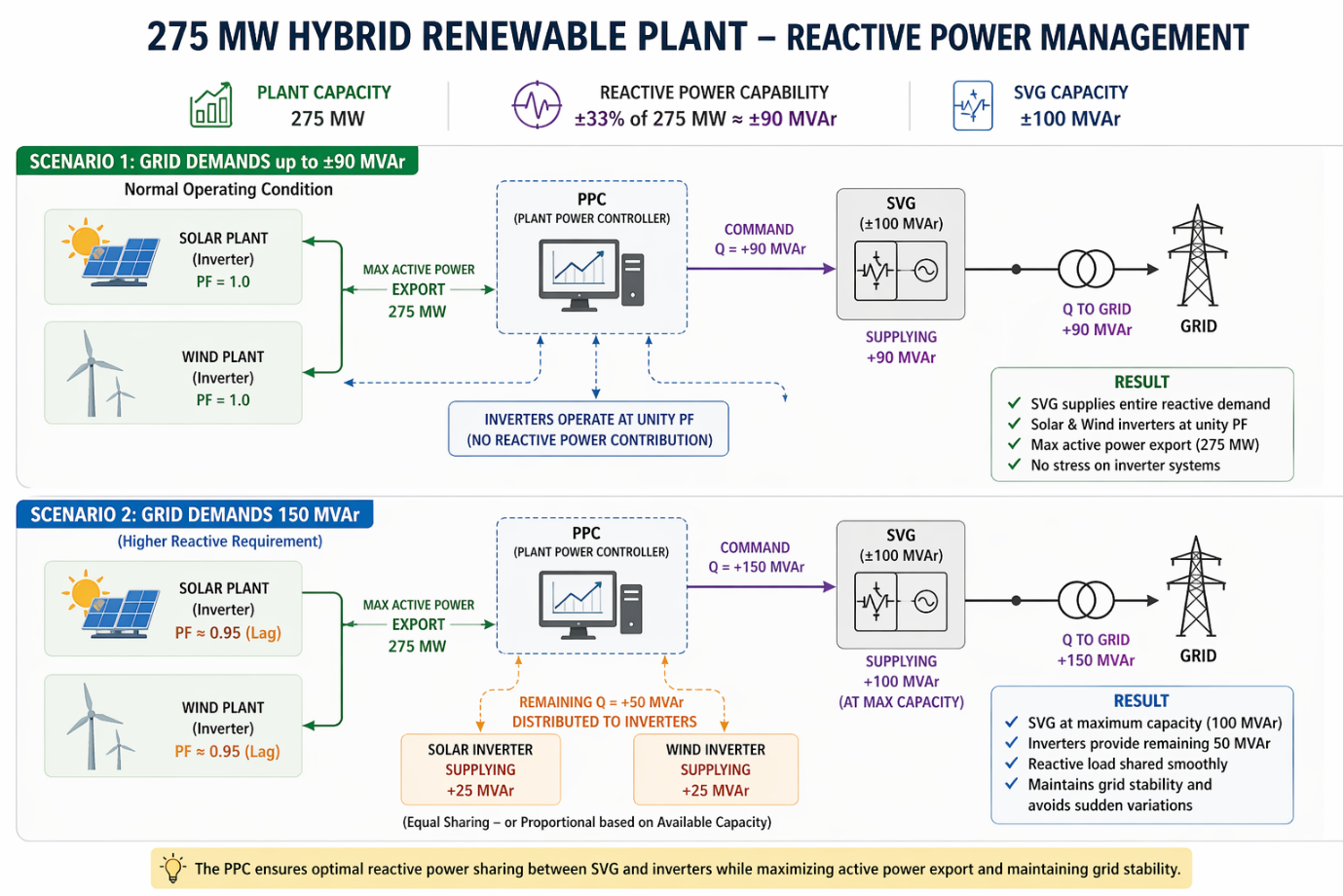
As per grid code requirements, the reactive power capability is approximately ±33%. This translates to around 90 MVAr. If the plant is equipped with a ±100 MVAr SVG, it can handle the entire reactive requirement under normal operating conditions.
In this scenario, the PPC commands the SVG to supply reactive power. Solar and wind inverters operate at unity power factor. This allows the plant to export maximum active power without stressing inverter systems.
Now consider a situation where the grid demands 150 MVAr. The SVG operates at its maximum capacity of 100 MVAr. The remaining 50 MVAr must be supplied by solar and wind inverters. The PPC distributes this requirement either equally or proportionally based on available capacity. This ensures smooth sharing of reactive load and avoids sudden changes that could destabilize the system.
The real challenge appears during grid disturbances. During voltage dips, reactive power demand increases sharply. At the same time, the ability of the plant to supply reactive power may reduce due to voltage-dependent limitations. The PPC handles this situation through prioritization.
Fast-acting devices such as STATCOM or synchronous condensers respond first. These devices are designed to inject reactive current quickly and stabilize voltage. If additional support is required, inverters are used. However, their contribution is limited by current and thermal constraints. The PPC ensures that all devices operate within safe limits while still meeting grid requirements.
This coordinated response helps the plant comply with fault ride-through (FRT) requirements and improves voltage recovery after faults.
In addition to reactive power, the PPC also manages active power output. In hybrid plants, generation sources are variable. Solar output depends on irradiance. Wind output depends on wind speed. Battery systems may be charging or discharging.
The PPC ensures that the total active power delivered to the grid follows the required schedule or dispatch command. It may curtail generation from one source while increasing output from another. It may also use battery storage to smooth fluctuations. This coordination improves grid stability and ensures compliance with dispatch requirements.
A well-designed PPC control philosophy provides several benefits.
- It ensures stable voltage at the POC.
- It helps meet grid code requirements.
- It maximizes active power export.
- It reduces unnecessary curtailment.
- It improves inverter life by avoiding excessive reactive loading.
- It provides strong response during grid disturbances.
Most importantly, it allows the plant to operate reliably under both normal and abnormal conditions.
Designing PPC logic is not simple, You must consider:
- Different response times of equipment
- Communication delays
- Measurement accuracy at POC
- Grid strength variations
- Interaction between multiple controllers
Poor tuning can lead to oscillations, slow response, or even instability. That is why detailed simulation studies using tools like PSCAD and PSSE are required before implementation.
In hybrid renewable plants, the PPC is not just a controller. It defines how the plant interacts with the grid. If the PPC logic is weak, you will see voltage issues, reduced generation, and grid compliance failures. If the PPC is designed correctly, the plant operates smoothly, delivers maximum energy, and supports the grid even during disturbances. As renewable penetration increases and grid strength decreases, a strong PPC control strategy becomes essential for every project.

No comment