
TGPR Study: Transient Ground Potential Rise Analysis for Substations and Plants
A TGPR study (Transient Ground Potential Rise study) measures how far the voltage of a grounding system rises above remote earth during fast events such as lightning strikes, switching operations and faults in gas-insulated substations. Standard earthing calculations are made at power frequency and can miss these short, high-frequency surges, which stress control cables, secondary equipment and people on site. Our engineers carry out each TGPR study with frequency-dependent grounding models and transient simulation, then recommend practical mitigation. It sits alongside our earthing study and insulation coordination study services.
What Is a TGPR Study?
Ground potential rise (GPR) is the voltage a grounding grid reaches relative to a distant reference earth when current flows into it. At power frequency this is a steady value calculated from fault current and grid resistance. During a fast transient, the same grid behaves differently. Its conductors act as inductive and capacitive elements, so the voltage varies across the grid and over time rather than staying uniform.
A TGPR study models that behaviour. It calculates the transient voltage at points across the grounding system, the voltages between remote earth and local equipment, and the stress these place on cables, enclosures and insulation. The result shows whether the standard design is enough, or whether extra measures are needed.
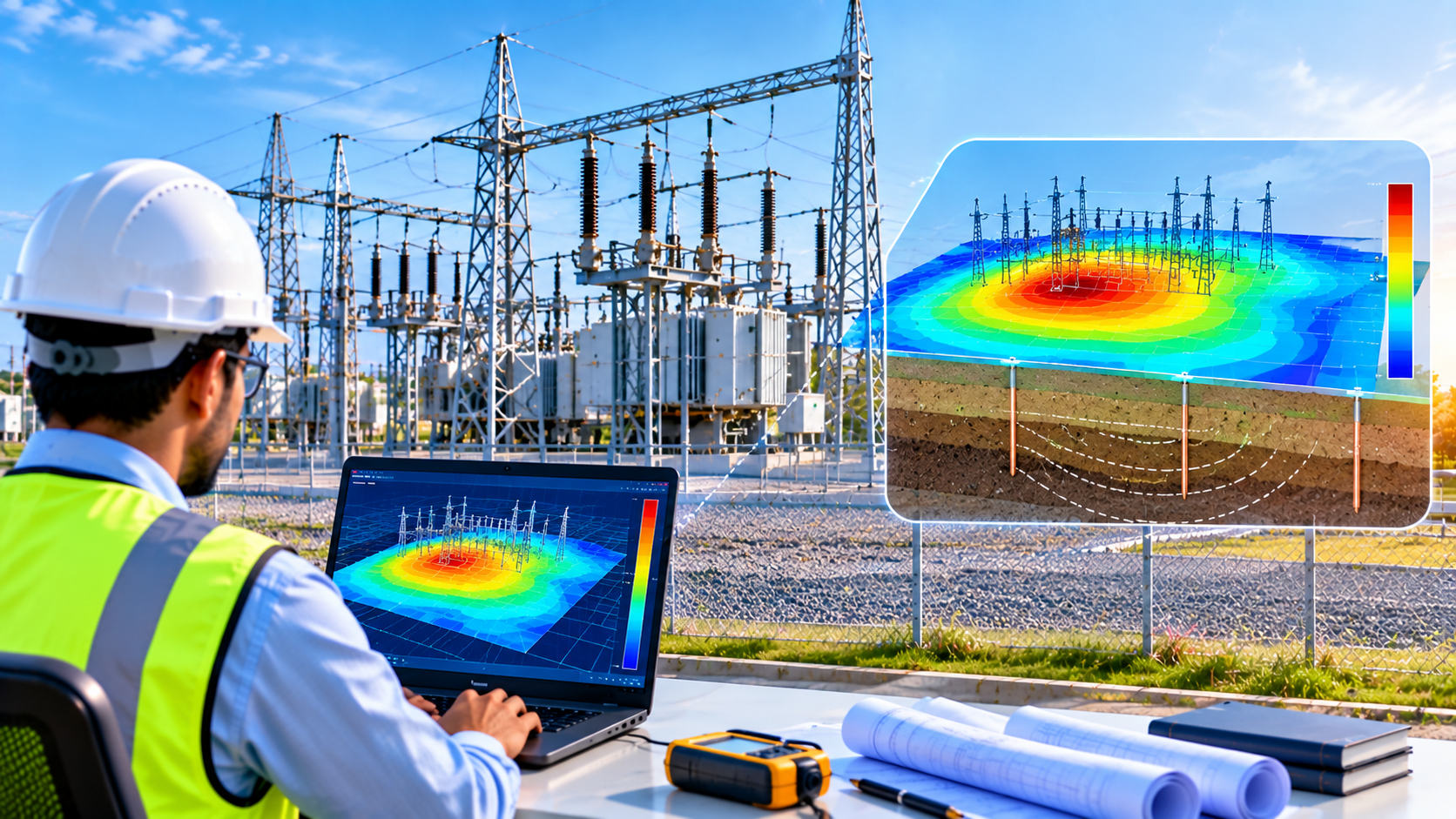
A grounding system that passes a power-frequency safety check can still see damaging transient voltages. That is the gap a TGPR study is designed to close.
Why a TGPR Study Matters
Transient voltages on the ground grid are short, but they reach equipment through every connection to earth. A TGPR study helps you find these risks before commissioning.
Control & Secondary Equipment
Surges coupled into control cables can damage relays, IEDs and low-voltage electronics.
Personnel Safety
Transient touch and step voltages near enclosures and structures can exceed safe levels.
Protection Misoperation
Noise injected through earth connections can cause protection and SCADA devices to mis-operate.
Insulation Stress
Voltage differences across enclosures and cable insulation can exceed withstand levels.
Design Confidence
Evidence that the earthing design performs under fast transients, not just at 50 or 60 Hz.
Lower Lifetime Cost
Fixing a weakness at design stage costs far less than repairing equipment after failures.
What Causes Transient Ground Potential Rise?
A TGPR study normally looks at the fast events most likely to drive current into the grounding system.
Lightning Strikes
Direct strikes to towers, shield wires or structures, and strikes near the site, inject high-frequency current into the grid.
Switching Operations
Disconnector and breaker operations, especially in gas-insulated substations, create very fast transients that couple to the enclosure and ground.
Faults on the Network
Line-to-ground faults produce a fast-rising current before the power-frequency value is established.
Renewable and Converter Plants
Large solar and wind sites with long collector cables and many earth connections can see wide voltage differences across the plant.
What Our TGPR Study Covers
- Grounding grid and soil model built from site data
- Frequency-dependent grounding impedance
- Transient simulation of lightning, switching and fault cases
- Transient GPR waveforms at key points on the grid
- Touch and step voltage assessment
- Voltage difference checks on enclosures and cables
- Mitigation options, such as extra electrodes, ring conductors and bonding
- Clear report with results, assumptions and recommendations
We use frequency-domain grounding software, such as the HIFREQ module of CDEGS, together with EMT simulation. Read about CDEGS training or our guide to PSCAD software.
How We Carry Out a TGPR Study
Collect Site Data
Earthing layout drawings, soil resistivity results, equipment locations, cable routes and the single-line diagram. See our soil resistivity test service if site measurements are not yet available.
Build the Grounding Model
The grid, electrodes and connected structures are modelled with the soil layers and conductor properties.
Simulate Transient Cases
Lightning, switching and fault events are applied and the transient voltage response is calculated across the grid.
Assess and Recommend
Results are compared with equipment withstand and safety limits, and design changes are proposed where needed.
Where a TGPR Study Is Used
- GIS and AIS substations
- Solar, wind and battery storage plants
- Transmission line terminations and towers
- Industrial plants with sensitive control systems
Related services include substation earthing design and lightning protection system design.
Standards Behind a TGPR Study
Power-frequency safety limits for substation grounding come from IEEE Std 80, with soil measurement guidance in IEEE Std 81. Lightning protection follows the IEC 62305 series, and overvoltage withstand levels are coordinated under IEC 60071. A TGPR study applies these references to the fast-transient case, where the limits are checked against transient results. The documents are available from the IEEE Standards Association and the International Electrotechnical Commission.
TGPR Study FAQs
What does TGPR stand for?
TGPR stands for Transient Ground Potential Rise. It describes the short-duration voltage rise of a grounding system during fast events such as lightning and switching.
What is the difference between GPR and TGPR?
GPR is calculated at power frequency from fault current and grid resistance. TGPR looks at the fast, high-frequency response, where grid conductors behave inductively and voltages vary across the site.
When is a TGPR study needed?
It is most useful for GIS substations, large renewable plants and sites with sensitive control and communication systems, or wherever lightning exposure or fast switching is a concern.
Is a TGPR study the same as an earthing study?
No. An earthing study confirms power-frequency safety, such as touch and step voltage and grid resistance. A TGPR study adds the fast-transient behaviour and complements the earthing design.
What do I need to provide for a TGPR study?
Typically the earthing layout, soil resistivity data, a single-line diagram, equipment and cable layouts, and the types of transient event you want assessed.
Need a TGPR Study for Your Project?
Share your substation or plant details and we will advise on the scope, data required and timeline. We typically respond within 24 hours.
- 1,000+ power system studies delivered across 50+ countries
- Frequency-domain grounding and EMT simulation expertise
- Practical mitigation recommendations, not just results
See our completed projects.
TGPR Study Enquiry
Your details are kept private and used only to respond to your enquiry.