
Why it is not advisable to use typical %Z and X/R ratio values while modelling a transformer in ETAP?
Transformer modelling in power system simulation tools require inputs such as rating, voltage ratio, impedance, X/R ratio, tap settings, vector group and so on. The accuracy of input data plays a critical role in determining the accuracy of simulation results. ETAP offers some typical data for impedance and X/R ratio for two winding transformers. One frequent mistake Power System Engineers make is completely relying on typical values of %Z and X/R ratio instead of the actual values as in the Factory Acceptance Test (FAT) report or Name plate data or data sheet. Going with typical values may seem like an easier option but ends up in inaccurate results.
Significance of %Z and X/R in Transformers
- %Z (Percentage Impedance):Defines the voltage drop across the transformer and impacts the fault current levels.
- X/R Ratio:It represents the ratio of leakage reactance and winding resistance. This ratio determines the real and reactive power loss across the transformer. It strongly impacts the decaying rate of the DC offset current.
Why Typical Values Are Not Advisable?
- Outdated transformer impedance in ETAP library
The typical values for transformer %Z and X/R ratio from ETAP library are based on IEC 60076-5:1994. However, the updated IEC standard was revised in 2006 (IEC 60076-5:2006), and the impedance ranges specified in the new edition differ from the old version. Continuing to use default values may lead to misleading results.
IEC 60076-5:2006

Impedance
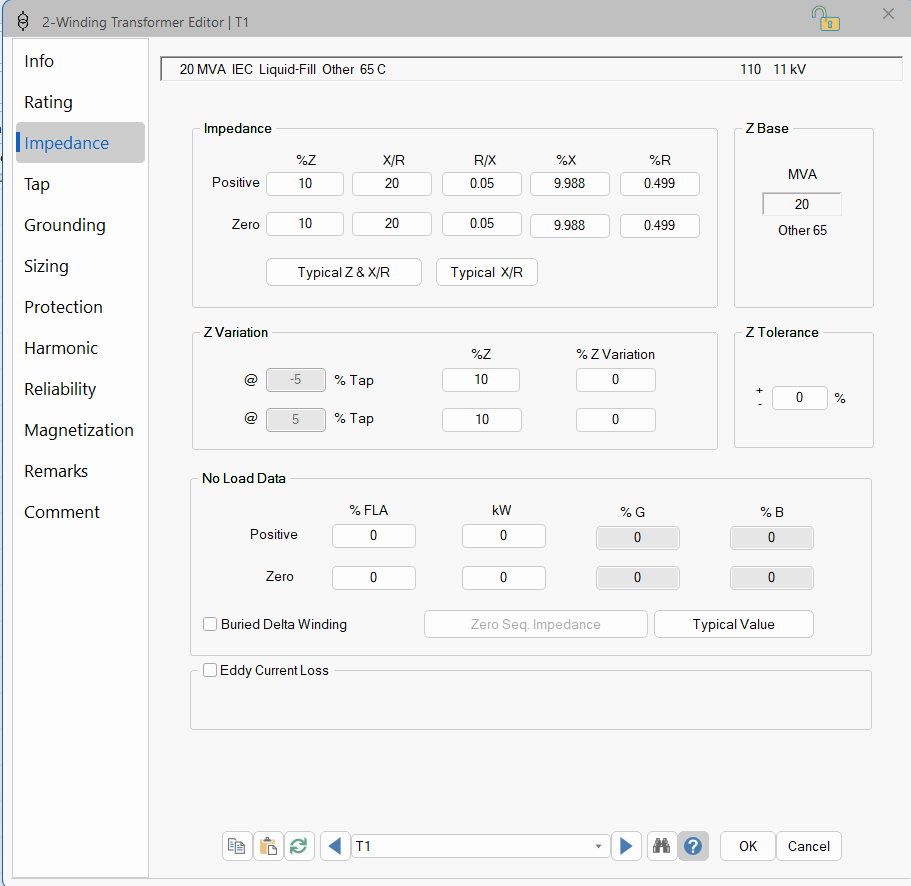
2. Impedance Variations
Transformer %Z and X/R are not universal. They vary based on:
- Transformer rating (kVA/MVA)
- Transformer HV and LV Voltage
- Design and cooling type
- Manufacturer’s design choices
Using typical values ignores these variations.
- Impact on Short Circuit Studies
Fault current calculations are highly sensitive to %Z and X/R. If wrong values are used:- Fault current magnitudes may be overestimated or underestimated.
- Breaker sizing and relay coordination may be incorrect.
- Arc-flash incident energy results may be unsafe.
Conclusion
While ETAP provides typical %Z and X/R values for convenience, they are based on IEC 60076-5:1994, an outdated standard whereas the updated IEC 60076-5:2006 provides different ranges. To ensure accurate results in power system studies, transformer models should always be built using FAT report or data sheet.




I had a great knowledge of Power System in Power Project. Thanks for guiding me. I got good knowledge. I appreciate it.
Good
love this
What X/R Values are to be used? Default or any other standard to be used?